
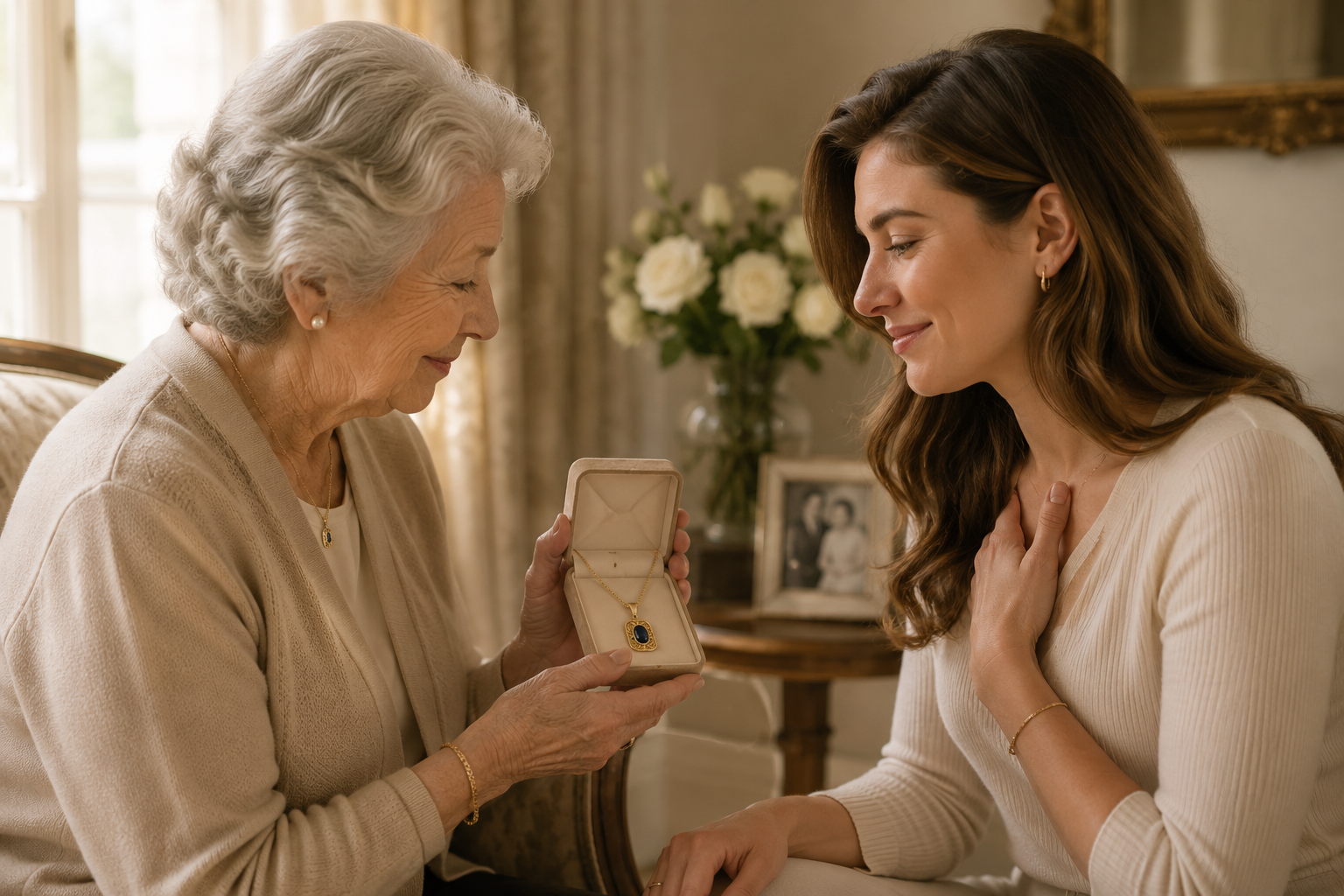
Gold is near record highs. As of August 2026, spot gold is trading around C$6,000 an ounce, roughly C$195 a gram, after a year that has seen all-time highs. Every jewellery box in West Vancouver just got heavier. The ring you never wear, the chain you forgot about, the earrings missing a pair, they all have a cash value now. So the question comes up at dinner tables all over the North Shore: sell it while gold is high, or keep it?
I'm Trish Arato. I've been a custom jeweller for 25 years, I'm a Graduate Gemologist with the GIA and a Fellow of the Canadian Gemmological Association, and I work from my studio in Ladner Village, about forty-five minutes from West Vancouver. Clients bring me inherited pieces every week and ask me this exact question. Here is the honest version of the answer, with the real numbers.
Your jewellery box just got heavier
Let's start with what the price actually means. Gold is quoted per troy ounce and per gram, and the number moves daily. This month, spot gold sits around C$195 a gram. From there, the math is simple: A gram of 14k gold is 58.5 percent pure gold. At C$195 spot, that gram is worth roughly C$114 at spot. A gram of 18k is 75 percent pure, so it's worth about C$146.
Run that against what's sitting in your drawer. A 20-gram 14k chain is over C$2,200 at spot. An 18k ring at 8 grams is over C$1,100. A full inherited lot, chains, rings, brooches, cufflinks, can easily add up to thousands of dollars in gold alone, before you even look at the stones. That's why gold buyers are advertising so hard right now. The number moves daily and the buyers want your metal at today's high.
What selling actually pays
Here is the part the ads leave out: spot is not the payout. When you sell gold jewellery for scrap, you do not get spot price. A gold buyer pays a percentage of spot, typically 70 to 90 percent depending on karat, weight, and volume. The rest is their margin, refining costs, and risk. A shop with overhead in a mall pays less than a refinery does. Mail-in buyers pay less still, and you're mailing irreplaceable pieces.
So that 20-gram 14k chain, C$2,200 at spot, might pay you C$1,700 to C$1,900 from a good local buyer, or a lot less from a cash-for-gold counter. Still real money. Nobody is arguing that. But here's the second part, and it's the one people skip: scrap pays melt value. You get paid for the gold, not the work, not the design, not the stones. Diamonds and coloured gemstones are typically worth nothing on a scrap ticket unless they're large or exceptional, and even then, expect a fraction of what you'd pay to replace them. That $5,000 retail ring from 1985 might bring $800 to $1,200 at resale, mostly for its gold. The stones, cut decades ago, are rarely valued at all.
Selling is a cash transaction. You get a cheque and the piece is gone. For some pieces that's exactly right. For others, it's a cheque and regret.
What redesign does instead
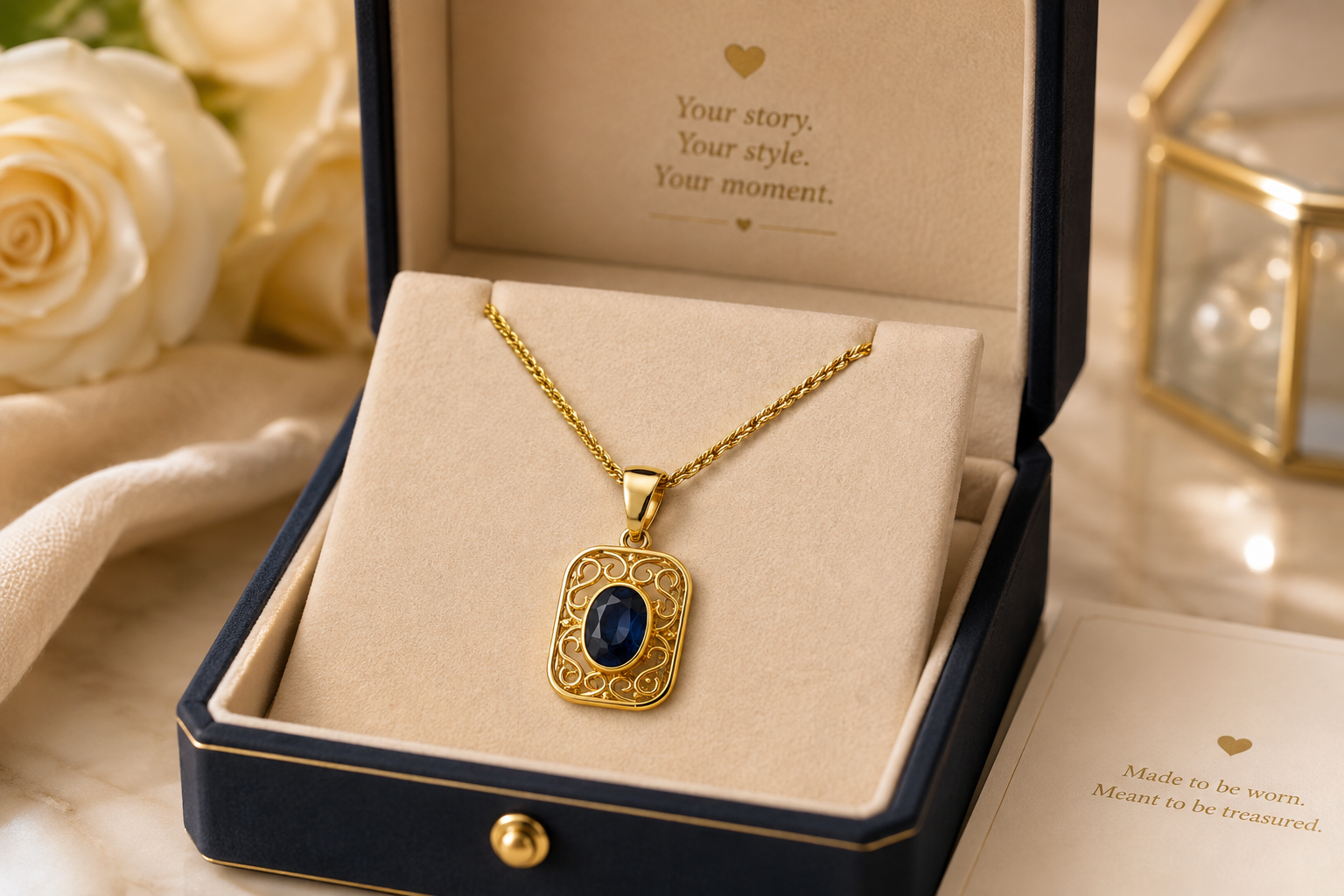
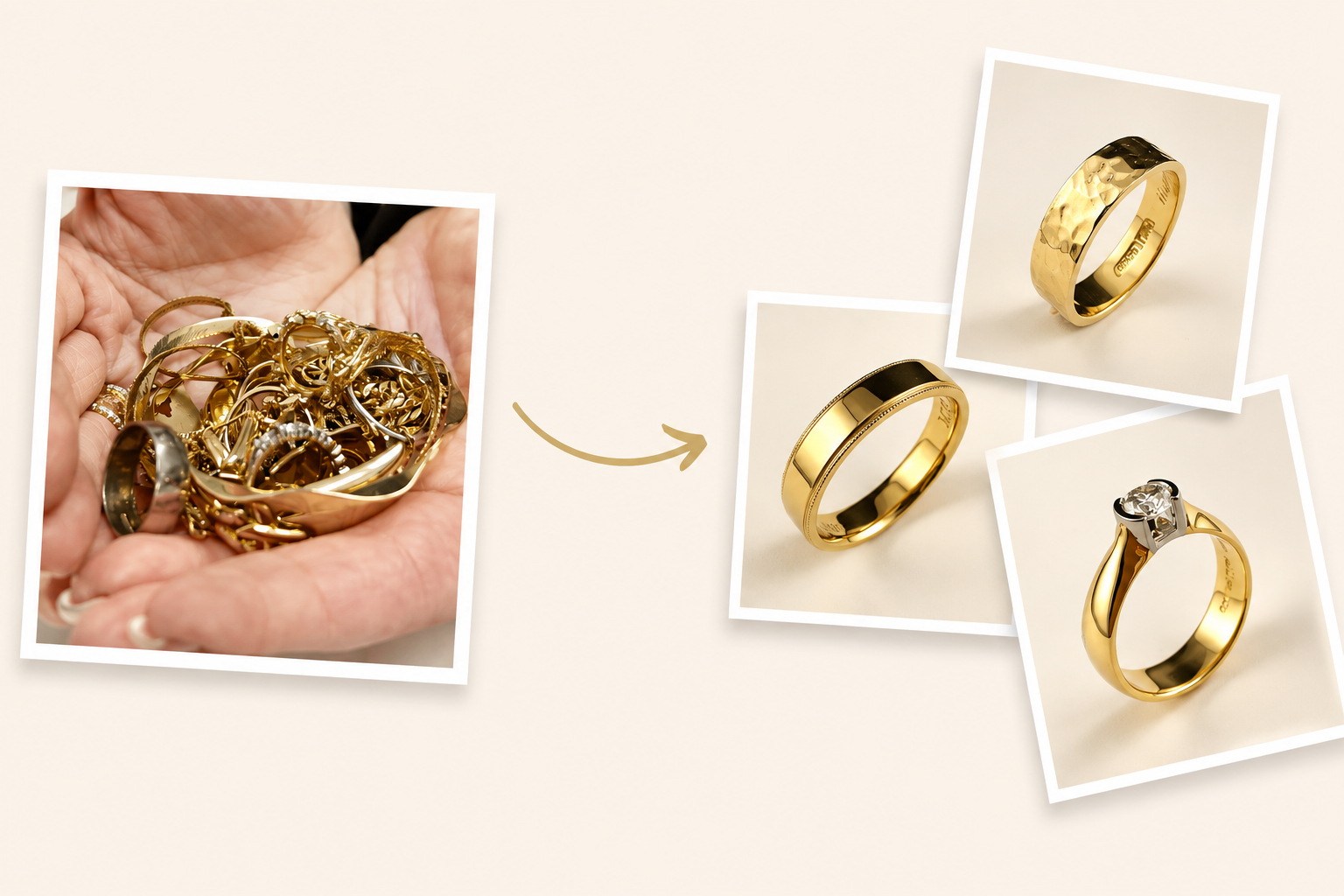
Redesign flips the transaction. Instead of converting the piece to cash, you convert it to something you'll wear. The gold is the same gold. It does not degrade, it does not wear out, it can be melted, refined, and recast without losing quality. When I redesign an inherited piece, the metal from your mother's ring literally becomes your new ring. Same gold, new design. The stones come out and get set into the new piece. The value you were going to sell for scrap becomes the material for a custom piece worth far more to you than the melt value.
Here's the thing about the gold price and redesign: the gold keeps its value either way. If you sell, you get today's price and lose the piece. If you redesign, you keep the gold, and the gold keeps its market value with it. The piece you wear is also an asset, insured and appraised, not a scrap ticket.
This is the most meaningful work I do. A ring your grandmother wore for forty years, rebuilt so you wear it every day. Stones from two generations combined into one new design. Same gold, new design, and the story continues instead of ending at a counter.
Don't let the price spike rush you
The gold price is doing something to people's judgement right now, and I want to be straight about it: don't sell on a deadline. Prices like these create urgency. Ads tell you today's rate, cash now, before it drops. That urgency is the sales technique, not the market reality. Gold has been on a long run. It hit record highs earlier this year, pulled back, and rallied again. Nobody knows where it goes next, and anyone who tells you they do is guessing.
A few things worth doing before you decide anything:
- Get the pieces weighed and tested. Know what you actually have. Karat, weight, stones. Not what the buyer says you have, what the pieces are.
- Get more than one quote. Compare a couple of established buyers, not the highest number in a window. Ask what percentage of spot they're paying.
- Get the stones assessed. If there are diamonds or gemstones, know what they are before you treat the piece as scrap. I have seen inherited pieces where the stones are worth more than the gold, and the owner almost sold them for nothing.
- Check your insurance. If your pieces are insured, look at the policy. Many policies cover jewellery at values set years ago, when gold was half the price. If you keep the pieces, insure it at replacement value, not at what you paid in 1995.
None of this takes long, and it costs nothing at my studio. An assessment gives you an honest read of what you have, so the decision is yours, not the buyer's.
Pieces worth selling
To be clear, selling is not wrong. Some pieces should go. If you inherited jewellery you feel no connection to, from someone you barely knew, and it's been sitting in a box for years, selling it into a strong gold market is a sensible move. Same for broken pieces beyond practical repair, single earrings, tangled chains, and jewellery that was never high quality to begin with. Turn them into something useful: a bill paid, a trip, a gift.
The line I draw is simple. Sell the pieces with no story attached. Think twice about the ones with one.
Pieces you'll regret selling
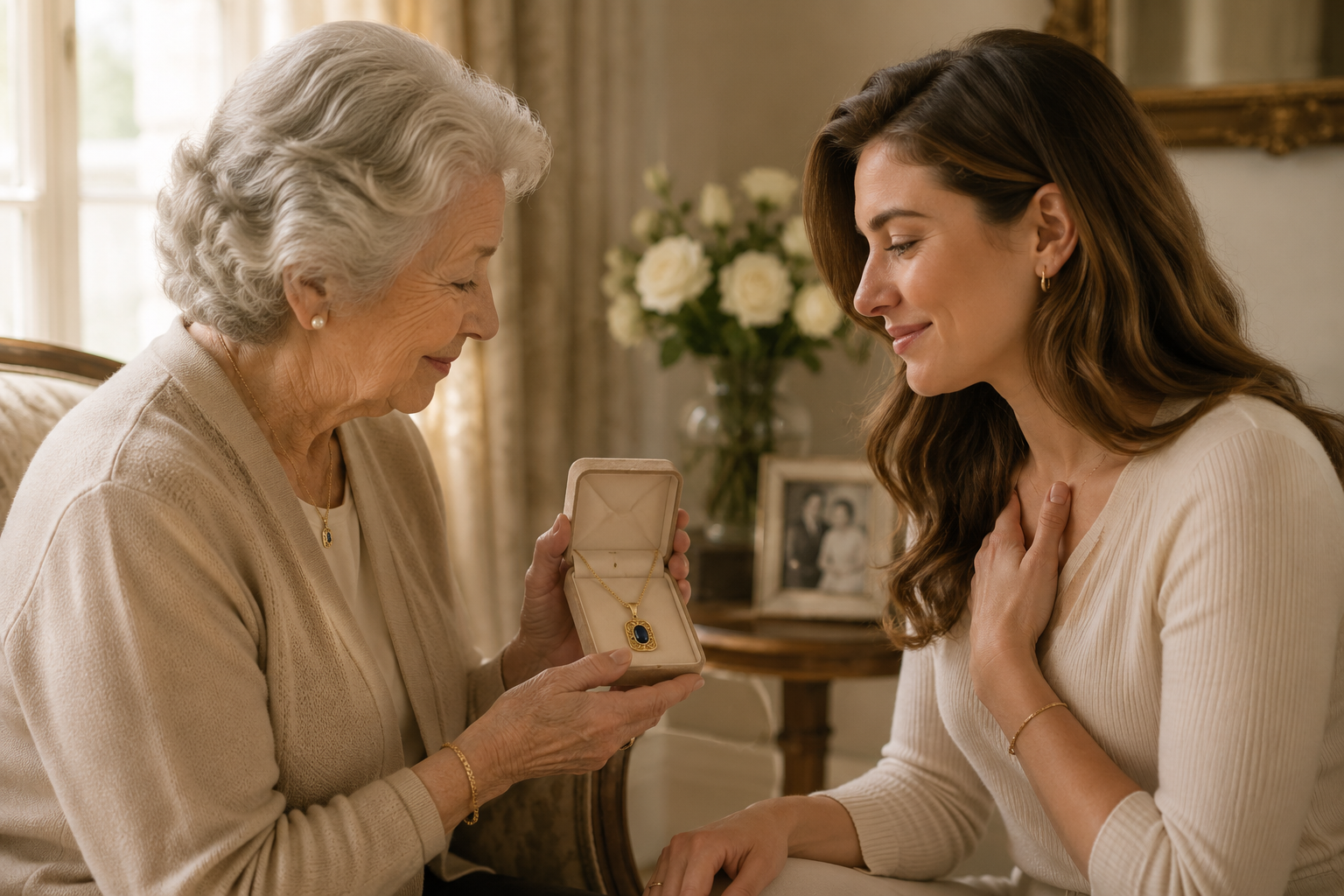
The pieces to slow down on are the ones with names attached. Your grandmother's engagement ring. Your mother's wedding band. The brooch your aunt wore to every family event you can remember. The diamonds from your parents' anniversary set. These pieces have a market value that is real but small, and a personal value that is not on any scrap ticket.
The most common regret I hear from clients is not selling the gold. It's selling the piece, then wishing they still had it. A cheque gets spent. The ring, once it's gone, is gone. You cannot buy it back. The stones are not replaceable, not at any gold price.
If you're on the fence about a family piece, bring it in before you sell it. Look at what a redesign would actually cost, compared to what the scrap ticket pays. More often than you'd think, the redesign is within reach, and you keep everything that mattered.
How the assessment works
When you bring your pieces to my studio, I do a full read: karat and weight on the gold, identification and condition on every stone, and a straight answer on what each piece is worth at scrap and what it could become. I also tell you when a piece should not be touched. A rare antique in original condition can have collector value that exceeds its redesign value, and I'll say so.
Some pieces are better preserved as they are. Some are better sold. Some are perfect redesign candidates. The honest answer is different for every box of jewellery, and you get it either way. There's no pressure to sell and no pressure to redesign. You leave with facts and a recommendation.
West Vancouver families and inherited jewellery
West Vancouver has a particular kind of jewellery box. Established families, pieces passed down through generations, and a lot of solid gold and natural diamonds from an era when jewellery was bought to last.
That's exactly the kind of material that pays off in a high gold market, and exactly the kind that deserves a second look before it's melted. The gold is worth more than it's ever been. The stones are the same stones your grandparents chose. My Ladner Village studio is an easy drive from West Vancouver, down Highway 1 and across the river, usually around forty-five minutes. Clients come from West Van, North Vancouver, Vancouver, and all over the Lower Mainland. Private, one-on-one consultations, just you and your pieces, no showroom, no rush.
Your move
You don't have to decide today. You just shouldn't decide without the facts. Bring your jewellery box to the studio, or start the conversation online. I'll tell you what the gold is worth at today's price, what the stones are, and what your options actually cost. Then the decision is yours, with your eyes open.
Book a consultation a consultation, or call the studio at (778) 999-3115. Appointments are one on one, and the gold price can wait a week. The piece you sell for scrap cannot come back.
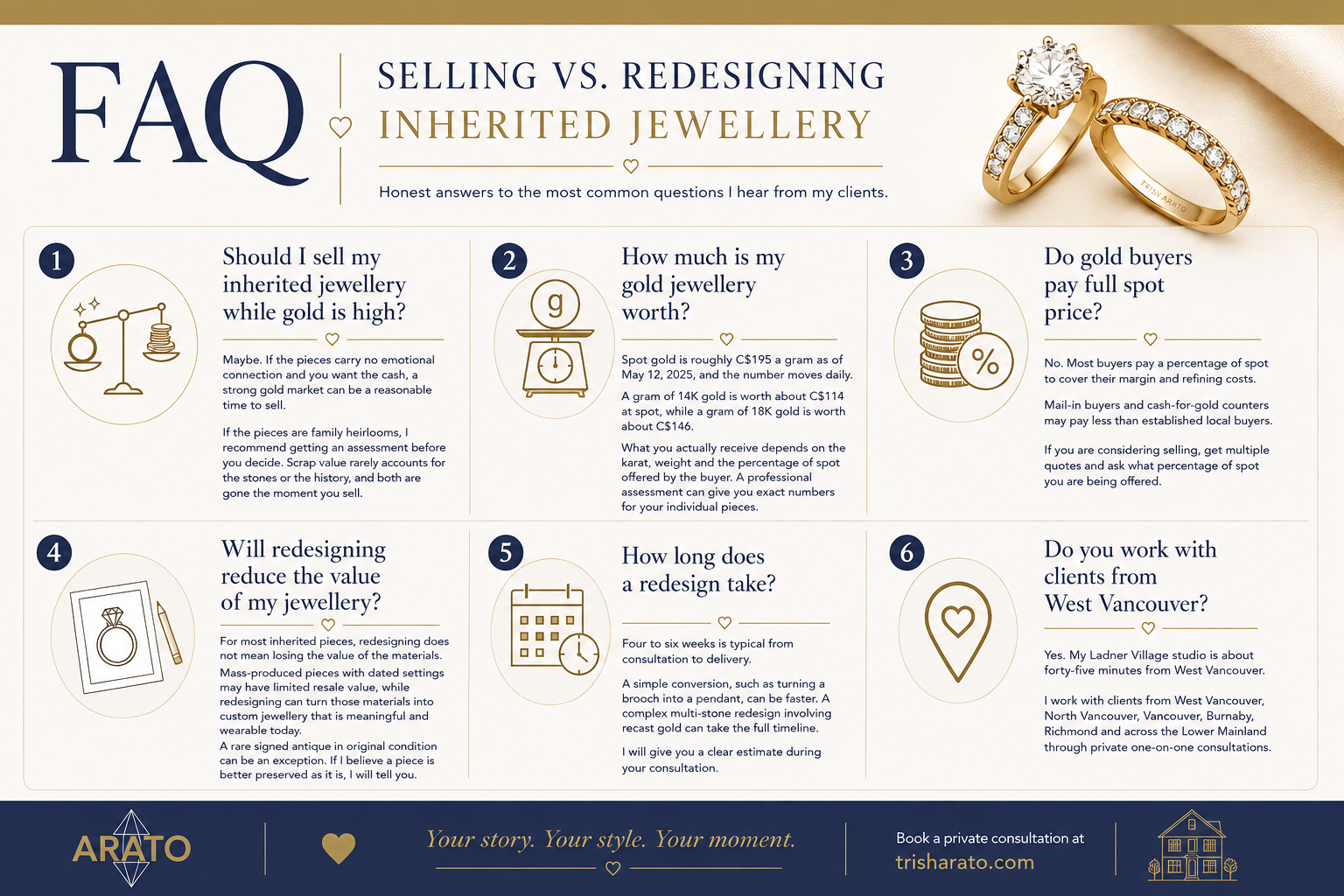
FAQ: Selling vs. Redesigning Inherited Jewellery
How do you test my gold?
I use a Gold XRF machine in the studio, which reads karat and purity instantly and without damaging the piece. No cutting, no acid testing, no sending it out to a lab. You get accurate numbers on the spot and can decide the same day whether to sell, redesign, or keep it.
Should I sell my inherited jewellery while gold is high?
Maybe. If the pieces carry no emotional connection and you want the cash, a strong gold market is a reasonable time to sell. If the pieces are family heirlooms, get an assessment before you decide. Scrap value rarely accounts for the stones or the history, and both are gone the moment you sell.
How much is my gold jewellery worth?
Spot gold is roughly C$195 a gram as of August 2026, and the number moves daily. A gram of 14k gold is worth about C$114 at spot, a gram of 18k about C$146. What you actually receive depends on the karat, the weight, and the buyer's percentage of spot. A professional assessment gives you exact numbers for your pieces.
Do gold buyers pay full spot price?
No. Most buyers pay a percentage of spot, typically 70 to 90 percent, to cover their margin and refining costs. Mail-in buyers and cash-for-gold counters often pay less than established local buyers. Get multiple quotes and ask what percentage of spot you're being offered.
Will redesigning reduce the value of my jewellery?
For most inherited pieces, no. Mass-produced pieces with dated settings have minimal resale value, and redesign turns them into wearable custom jewellery worth more to you than the scrap or resale value of the components. A rare signed antique in original condition is the exception, and I'll tell you if your piece is one.
How long does a redesign take?
Four to six weeks is typical from consultation to delivery. A simple conversion, like a brooch to a pendant, can be faster. A complex multi-stone redesign with recast gold takes the full timeline. You get a clear estimate during the consultation.
Do you work with clients from West Vancouver?
Yes. My Ladner Village studio is about forty-five minutes from West Vancouver. I serve clients from West Vancouver, North Vancouver, Vancouver, Burnaby, Richmond, and across the Lower Mainland, in private one-on-one consultations.
Looking for more inspiration? Explore my Birthstone Guide to discover meaningful gemstones for every occasion.