What to Do With Inherited Jewellery You Don't Wear
Inherited jewellery often comes with a story. It might be your grandmother's ring, a necklace passed down from your mother, or a pair of earrings you have kept for years but never worn.
These pieces can hold wonderful memories, even when they don't quite suit your personal style.
One of the questions I hear from clients at my Ladner Village studio is, "What can I do with inherited jewellery that I don't wear?"
The good news is that you have more options than you might think. Sometimes a simple repair is all a piece needs. Other times, redesigning it can give it a new purpose while keeping its sentimental meaning.
And sometimes, the best choice is to leave it exactly as it is.
Before making any changes, I always recommend looking at the condition of the jewellery, understanding its value, and considering what you would actually enjoy wearing.
Here are six options worth exploring.
Why Does Inherited Jewellery Often Go Unworn?
Jewellery is personal, and the pieces we inherit were originally chosen for someone else's style and lifestyle.
Perhaps you've inherited a beautiful cocktail ring that feels too large for everyday wear. Maybe you have a brooch that doesn't work with your wardrobe or a gold necklace that simply isn't your taste.
Sometimes the problem isn't the design at all.
An older ring may have a worn band or loose stone. A bracelet might need a new clasp, or a strand of pearls may need restringing before it can be worn safely.
I often remind my clients that loving a piece of jewellery doesn't necessarily mean they have to wear it in its original form.
What matters is understanding your options before making a permanent decision.
Start by Looking at What You Have
Before deciding whether to repair or redesign inherited jewellery, I suggest separating your pieces into three groups.
Keep as they are: Pieces you already love wearing, or jewellery that may have historical, antique, or collector value.
Restore and wear: Jewellery that suits your style but needs cleaning, resizing, or minor repairs.
Consider for redesign: Pieces with beautiful gemstones or valuable materials that you are unlikely to wear in their current form.
Not everything needs to become a new design. Sometimes an assessment reveals that a piece is better preserved, repaired, or evaluated for its metal value.
Once you understand what you have, making the next decision becomes much easier.
Option 1: Restore Your Inherited Jewellery
Sometimes the simplest solution is also the best.
A ring that hasn't been worn in years might only need resizing and a professional cleaning. A bracelet could become a favourite again with a secure clasp, while an inherited pearl necklace may be ready to wear after restringing.
Before recommending any work, I look at the condition of the piece.
Older settings can become fragile, prongs can wear down, and gemstones may have existing damage that isn't immediately visible.
Cleaning also requires care. Not every gemstone responds well to the same treatment, particularly pearls and certain treated stones. If you're unsure about an inherited piece, have it checked before attempting to clean it at home.
For jewellery that is still structurally sound, a few thoughtful repairs may be enough to make it wearable again.
And there's something lovely about being able to enjoy a family piece without changing its original design.
Option 2: Redesign Inherited Jewellery Into Something New
If you love the meaning behind a piece but can't imagine wearing it as it is, redesigning it may be the right choice.
An inherited diamond ring could become a contemporary design that feels more comfortable for everyday wear. Gemstones from an older pendant might find a new home in a bracelet or a different necklace.
The goal isn't to erase the original piece's history. It's to carry an important part of that history into something that feels more personal to you.
When I work on an inherited jewellery redesign, I begin by assessing the gemstones, settings, and metal.
Some stones can be safely reset, while others may need a more protective design. Similarly, old gold isn't always suitable for direct reuse in a new piece. Depending on its alloy and condition, it may need refining or may be better used as credit toward new materials.
I explain these possibilities before anything is taken apart.
If you are considering redesigning a family diamond, you can also read my guide to resetting a family diamond into a modern ring.
I also encourage clients to photograph their original jewellery and write down its story before the redesign begins. Those small details can become an important part of the finished piece's history.
Option 3: Combine Several Pieces Into One Meaningful Design
Many families have a jewellery box filled with pieces that no longer get worn.
There may be several small rings, a pair of earrings missing a stone, broken chains, or gemstones from different generations.
Rather than keeping everything tucked away, you might be able to combine selected elements into one custom piece.
For example, gemstones from two family rings could become part of a new multi-stone ring. A collection of smaller stones might inspire a pendant with a more personal connection.
Of course, not every material is suitable for combining.
I assess each gemstone and the metal before recommending a design. I also consider whether any original piece should remain intact, particularly if it has potential collector or historical value.
The finished jewellery should feel intentional, beautiful, and comfortable to wear, rather than simply being a collection of everything available.
Option 4: Convert Your Jewellery Into Something Different
Not every transformation requires a completely new design.
Sometimes changing how a piece is worn can make all the difference.
An inherited brooch, for example, may be suitable for conversion into a pendant. A single earring that has lost its partner might become the starting point for a small ring or charm.
Even certain vintage clip-on earrings can be adapted for pierced ears, depending on their construction.
What I like about these transformations is that they may allow much of the original design to remain recognizable while giving the jewellery a new purpose.
Before making changes, I consider how the piece will attach, balance, and sit when worn.
It's also important to understand whether the conversion can be reversed, especially if the original jewellery is an antique.
A small adjustment can sometimes make a treasured piece relevant to your life again.
Option 5: Trade the Value of Old Gold Towards a New Piece
Sometimes inherited jewellery isn't suitable for repair or direct reuse.
You may have broken yellow gold chains, damaged rings, or pieces that hold little sentimental meaning but still have material value.
In these situations, assessing the gold for its trade-in value may be worth considering.
At my Ladner Village studio, I evaluate eligible unused yellow gold and explain the options available, including payment or applying the agreed value towards a new custom design.
The amount depends on the gold's assessed characteristics and current market pricing.
It's important to understand that using the value of old gold towards a new piece isn't necessarily the same as melting that exact gold into a new design.
I explain the metal assessment and proposed custom jewellery costs separately, so you know what you're choosing.
If you have antique, signed, or potentially collectible jewellery, I recommend understanding its value as an intact piece before considering a metal-value offer.
Option 6: Keep Your Inherited Jewellery Exactly as It Is
This is an option I never want clients to overlook.
Not every inherited piece needs to be changed, repaired, or worn.
Perhaps you have a ring that belonged to someone especially important to you. You may love everything about it, even if you'll never wear it yourself.
Or perhaps you're simply not ready to make a decision.
That's perfectly fine.
Some jewellery is worth preserving in its original condition, especially pieces with historical or collector significance.
Store each item carefully in a separate pouch or compartment to reduce scratching and unnecessary wear. Keep a record of where it came from, along with any photographs or family stories that make it meaningful.
You can always revisit the decision later.
How Do You Know Which Option Is Right?
When clients bring inherited jewellery into my studio, I don't expect them to arrive with a finished design in mind.
We start by looking at what they have.
If you're deciding what to do with your own pieces, here are a few useful questions to consider:
- Does the jewellery have sentimental, historical, or collector value?
- Would I wear it if it were cleaned, repaired, or resized?
- Are the gemstones suitable for resetting?
- Can the existing gold be reused, or would its trade-in value be more practical?
- Would I prefer several original pieces or one custom design?
- Am I ready to make a change, or would I rather wait?
There isn't one correct answer for every jewellery box.
You might decide to restore your grandmother's ring, redesign a pendant, trade in a broken chain, and leave another piece untouched.
Each decision should reflect the jewellery itself and what matters to you.
Giving Inherited Jewellery a New Chapter
Inherited jewellery connects us to people, memories, and moments that are part of our lives.
Whether you choose to preserve the original design or transform it into something new, that connection deserves to be treated with care.
At my Ladner Village studio, I help clients explore these possibilities one piece at a time. We look at the condition of the jewellery, what can safely be reused, and whether a repair, conversion, redesign, or metal-value assessment makes the most sense.
If you'd like to learn more about the design process, visit my Inherited Jewellery Transformation page.
The most important thing is choosing an option that feels right for you.
Frequently Asked Questions
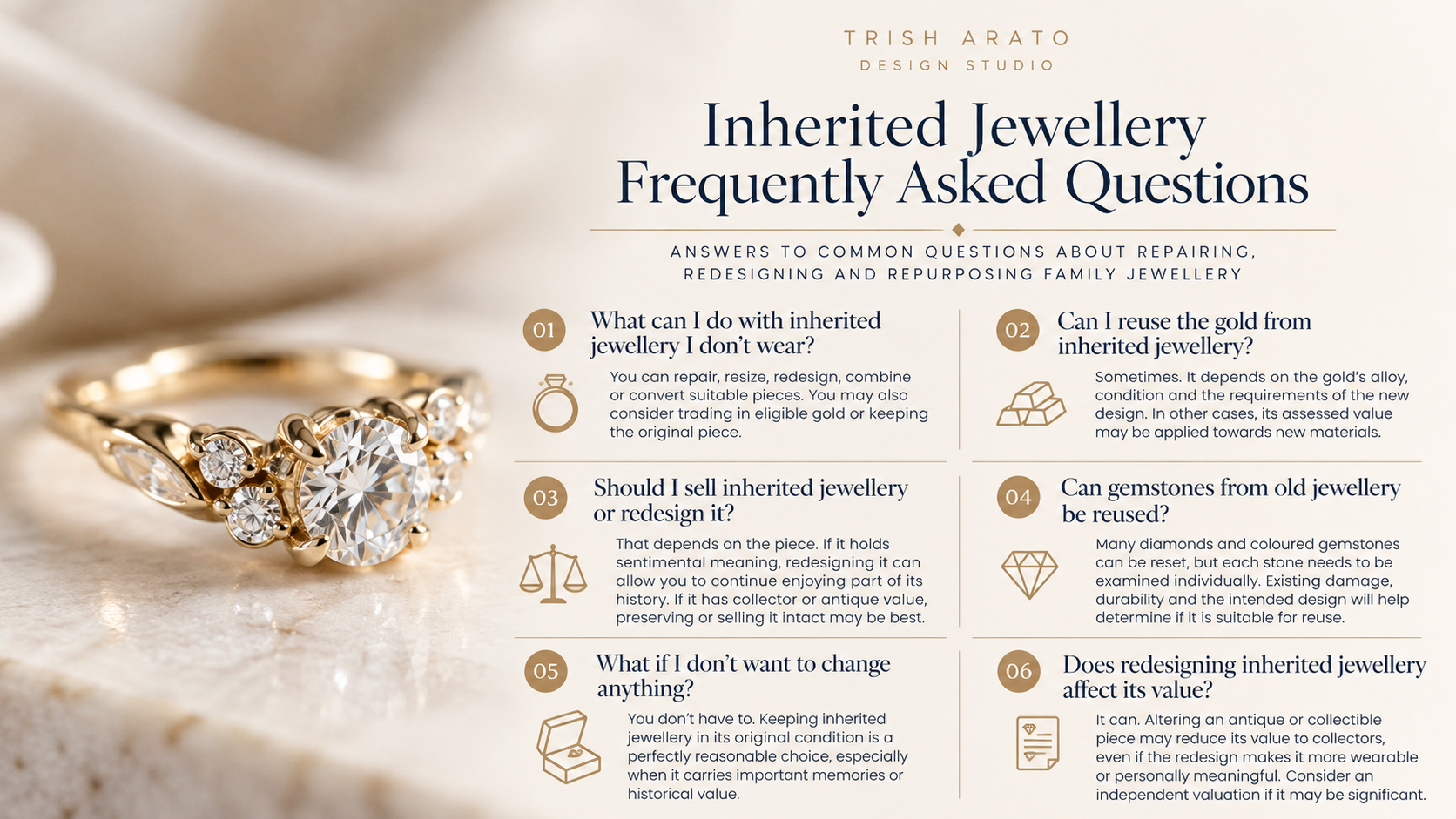
What can I do with inherited jewellery I don't wear?
You can repair, resize, redesign, combine, or convert suitable pieces into jewellery you'll enjoy wearing. You may also consider trading in eligible gold for its metal value or preserving the original piece. The best option depends on its condition, value, and personal meaning.
Can I reuse the gold from inherited jewellery?
Sometimes. Whether old gold can be directly reused depends on its alloy, condition, and the requirements of the new design. In other cases, its assessed metal value may be applied towards new materials.
Should I sell inherited jewellery or redesign it?
That depends on the piece. If it holds sentimental meaning, redesigning it may allow you to continue enjoying part of its history. If it has collector or antique value, preserving or selling it intact may be worth considering. An assessment can help you compare your options.
Can gemstones from old jewellery be reused?
Many diamonds and coloured gemstones can be reset, but each stone needs to be examined individually. Existing damage, durability, and the intended design will help determine whether it is suitable for reuse.
What if I don't want to change anything?
You don't have to. Keeping inherited jewellery in its original condition is a perfectly reasonable choice, especially when it carries important memories or historical value.
Does redesigning inherited jewellery affect its value?
It can. Altering an antique or collectible piece may reduce its value to collectors, even if the redesign makes it more wearable or personally meaningful. If a piece may have historical significance, consider an independent valuation before making permanent changes.
Book a Private Consultation
Do you have inherited jewellery sitting in a drawer because you're not sure what to do with it?
Bring it to my Ladner Village studio, and we can explore the possibilities together.
Whether it needs a simple repair or you're considering a complete redesign, I'll help you understand your options before making a decision.
Book a private consultation at trisharato.com.