
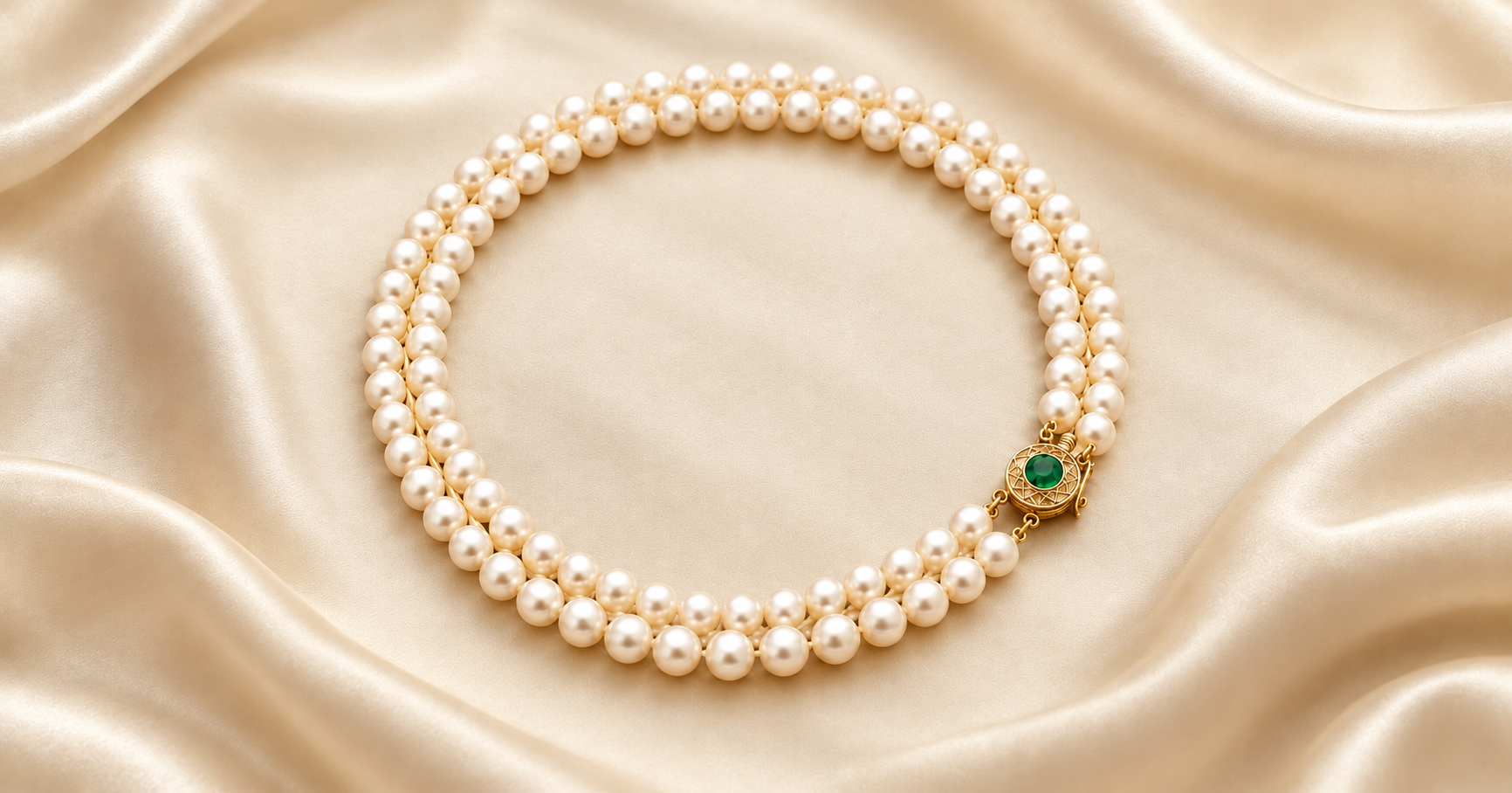
For most traditional pearl strands, I recommend a knot between each pearl. Pearl necklace knotting separates neighbouring pearls and helps limit how many can slip off if the thread breaks. An unknotted strand can still be a deliberate design choice. I would choose the construction around the necklace, how it sits and the finish you want, rather than assume one rule suits every piece.
If you are bringing an existing necklace in for restringing, start with a simple question: do you want it to feel the same when you put it back on? That answer matters as much as whether you can see knots.
How pearl necklace knotting protects a strand
A pearl necklace is a line of individual pearls carried on thread. In a knotted strand, small knots sit between the pearls instead of letting them rest directly against one another.
Knots separate the pearls. That separation helps reduce contact between their surfaces. Pearls need a gentler approach than many other gems: GIA describes pearls as easily scratched, with a hardness of 2.5 on the Mohs scale.
The other benefit is what happens when thread breaks. Knots create barriers along the strand, so a break does not necessarily leave a whole row free to slide off. GIA recommends knots for these two reasons in its pearl buyer's guide.
Knots help contain loss. They do not make the thread unbreakable or guarantee that a necklace cannot come apart. The position of a break and the condition of the strand still matter.
For a classic strand you want to wear and enjoy, those are practical reasons to favour knotting. The small spaces also become part of its appearance. You see a sequence of individual pearls, with a little breathing room between them.
When unknotted restringing can suit the design
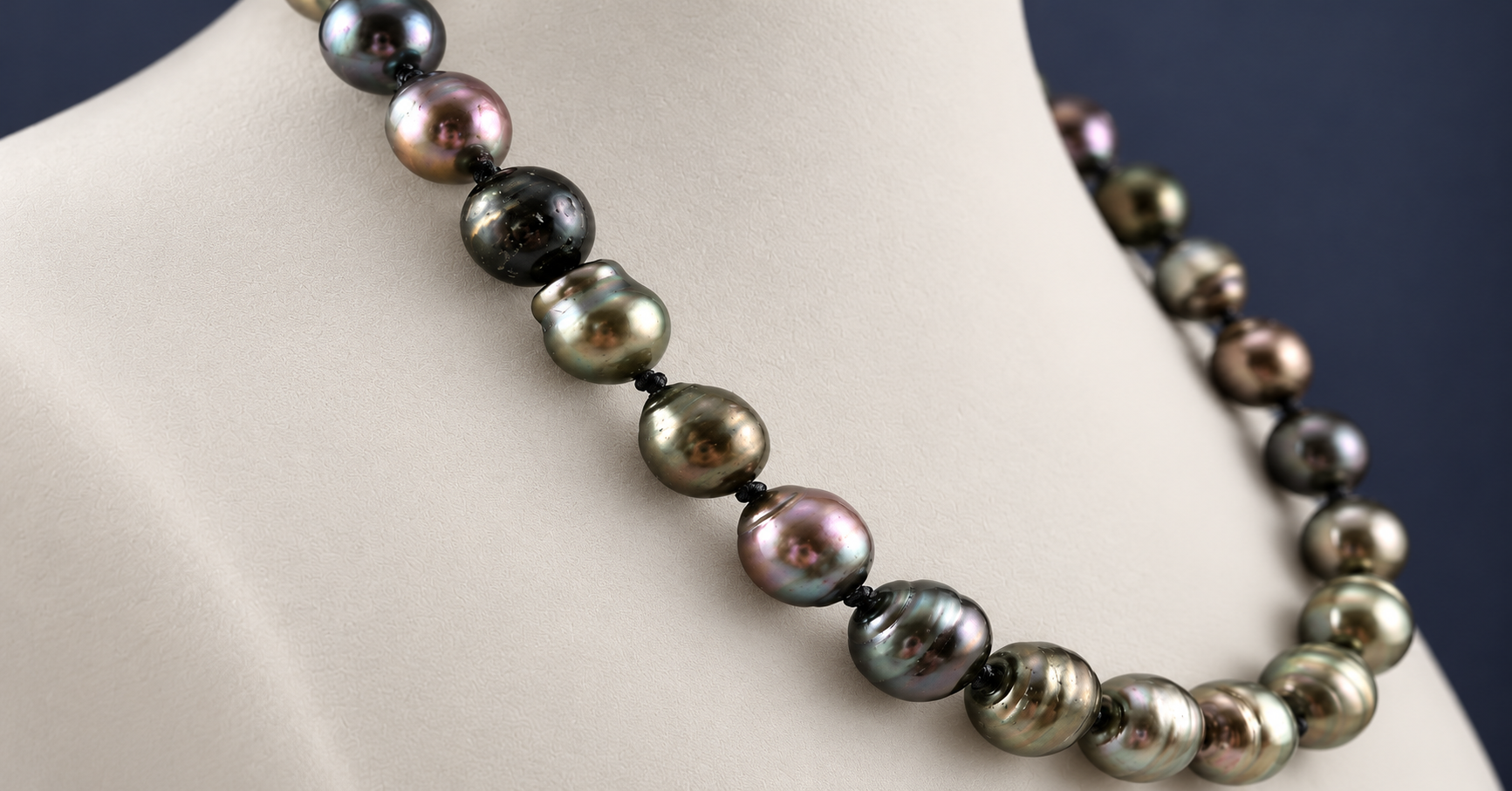
Unknotted is a choice. It is not automatically a sign that a necklace was made badly. On an unknotted strand, the pearls sit more closely together. That can be part of the original design and the look you want to retain.
I offer both knotted and unknotted restringing. If you like the close line of pearls in your necklace, tell me. I can look at the existing construction and explain what changing it would mean for the spacing and finished length.
My recommendation for a traditional strand is usually to keep the protection of individual knots. If you prefer an unknotted finish, I would discuss that preference with you in the context of the actual necklace. You should understand the trade-off before it is restrung, rather than discover a different look afterwards.
The same applies in reverse. If your necklace is already knotted and hangs beautifully, there is no need to remove the knots simply because a more tightly packed strand looks different in a photograph.
What to compare before changing an existing strand
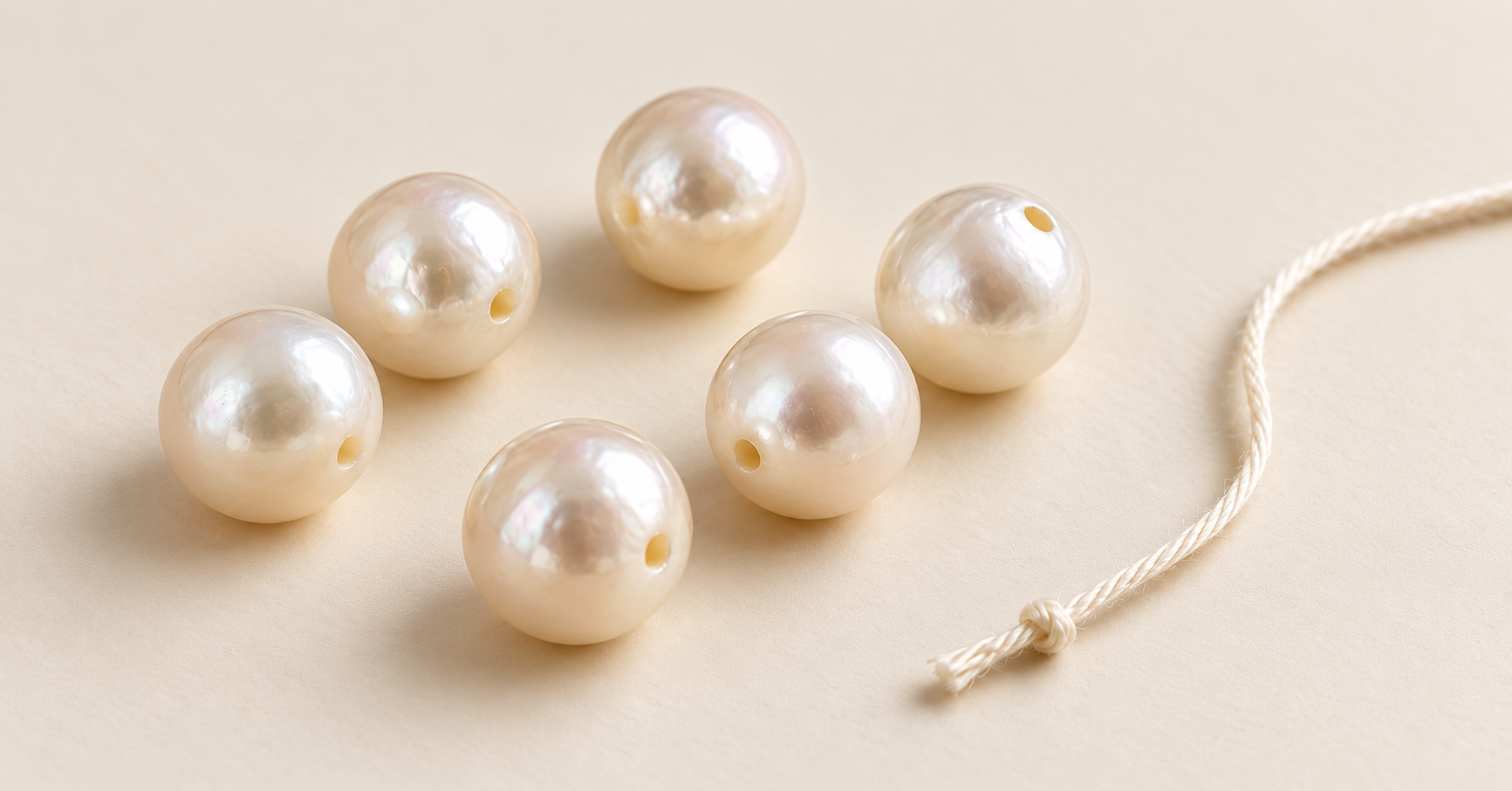
It is easy to focus on the knots and forget the whole necklace. I would compare the following details before deciding how to restring it.
| Detail | What it changes | What to tell me |
|---|---|---|
| Spacing between pearls | The rhythm of the strand and how closely the pearls sit | Whether you like the current close or separated look |
| Finished length | Where the necklace rests when worn | Where you want it to sit, and whether the current length feels right |
| Clasp and strand arrangement | How the complete necklace comes together | Whether the clasp sits where you want it, especially on a double strand |
| Existing construction | The starting point for the work | Whether preserving the original appearance matters to you |
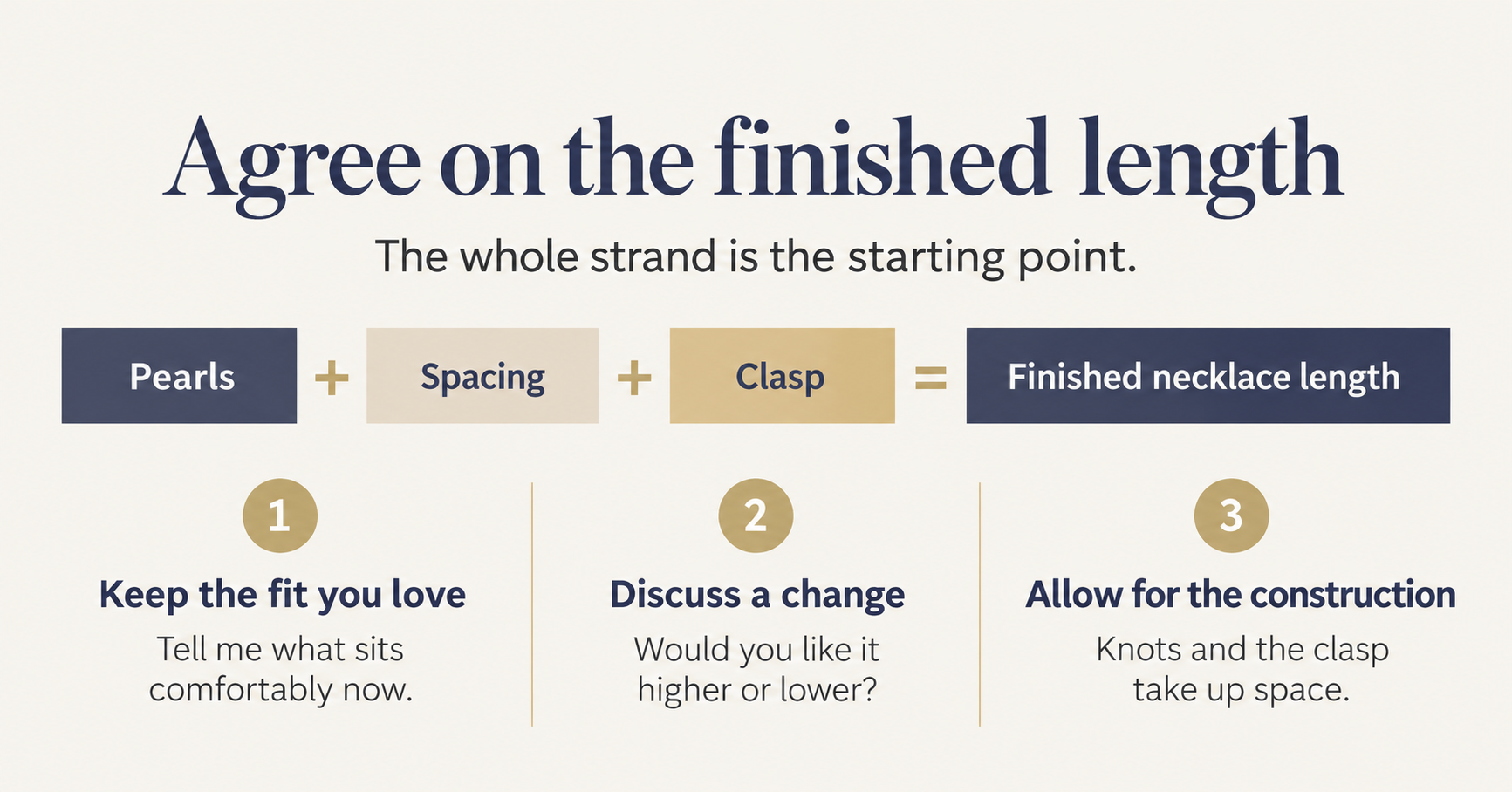
Agree on finished length. Knots take up space. Adding a knot between each pearl can change the length of a previously unknotted strand if the same pearls and clasp are retained. The amount depends on the actual construction, so I would not choose a new length from a generic online estimate.
If the necklace is already stretched, its current length may not be the length you want to reproduce. Bring a photograph of yourself wearing it when you liked the fit, if you have one. That gives the conversation a useful starting point without making you guess at a measurement.
Consider both strands together. With a double-strand necklace, the relationship between the rows matters. I would discuss how you want them to sit together and where the clasp belongs, rather than treat the two rows as unrelated lengths.
You do not need the technical vocabulary for any of this. “I love it as it is, but it feels too loose now” tells me something useful. So does “I would wear it more if it sat a little higher.”
Knotting does not identify the pearls
Knots are not authentication. They describe how the necklace is put together, not what the pearls are. Seeing knots is not enough to establish whether pearls are natural, cultured or imitation. Equally, the absence of knots does not settle that question.
GIA distinguishes pearl types by their formation and identification characteristics in its pearl buyer's guide. Thread construction is a separate decision.
If you have inherited a necklace and know little about it, bring along any original receipt or paperwork you have. You do not need to try a scratch test or another home experiment before asking for help. I would rather you keep the piece intact and bring your questions with it.
What I check before restringing
Start with the whole necklace. In my pearl restringing service, I examine the strength of the thread, the condition of each pearl and the clasp. Those checks help establish what the work needs to address.
Then I want to know how you hope to wear it. Is this a short strand you reach for with an open neckline? A longer necklace you want to keep at its current length? A double strand whose clasp is part of the design? The answer helps make the finish useful to you.
I would also ask whether your priority is to preserve its existing appearance or make a considered change. An inherited necklace can carry a familiar shape as well as sentimental value. You can keep that look while attending to worn thread; restringing does not have to become a redesign.
Describe the fit you want. If you can, bring the complete necklace rather than only a description of its pearls. If it has broken, keep the loose pearls and clasp together in a small closed container and bring those too. That gives me the actual pieces to work from.
For the service details, you can read about my pearl necklace restringing services. If your question is about looking after a sound strand between visits, my guide to caring for a pearl necklace between restringing covers wearing, cleaning and storage.
Questions to bring with your necklace
You do not have to decide on the construction before your appointment. These questions will help make the conversation specific:
- Do I like where this necklace sits, or would I prefer a different finished length?
- Do I want to preserve its current spacing and appearance?
- If I am changing from unknotted to knotted, what will that mean for the finished necklace?
- Does the clasp need attention, and do both strands sit the way I want?
- Is there anything about the original necklace I particularly want to keep?
Bring your preferences, too. A technically sound strand should also be one you enjoy wearing. I can explain the construction; you can tell me what you love about the piece and what has stopped you putting it on.
FAQ
Should every pearl in a necklace have a knot?
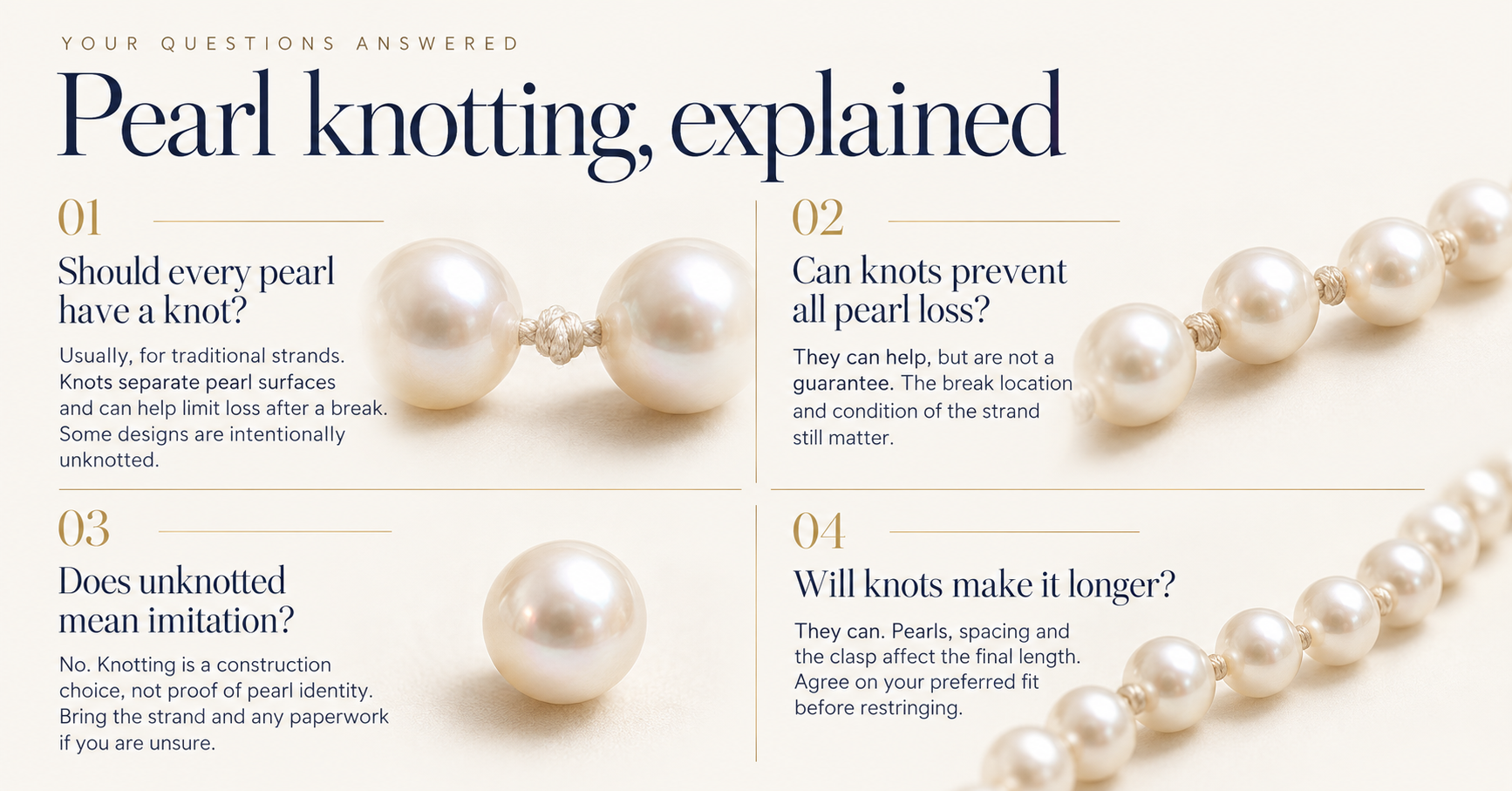
For most traditional pearl strands, I recommend knots between the pearls because they separate the surfaces and help limit loss after a thread break. Some necklaces are deliberately unknotted, so I would consider the design and your preferred finish before changing an existing strand.
Will knots stop all the pearls falling off if the thread breaks?
Knots can help keep neighbouring pearls from sliding off the strand, but they are not a guarantee against every break. The location of the break and the condition of the construction still matter.
Does an unknotted necklace mean the pearls are imitation?
No. Knotting is a construction choice, not a test of pearl identity. If you are unsure what you have, keep the necklace intact and bring it in with any paperwork rather than relying on the presence or absence of knots.
Will adding knots make my pearl necklace longer?
It can, because knots occupy space between pearls. If you want to add knots while keeping a particular finished length, discuss that before restringing so the plan accounts for the pearls, thread spacing and clasp together.
Bring your strand in
Keep the finish personal. If you are unsure whether your pearls should be knotted, bring the necklace and tell me how you want it to feel when you wear it. I can explain the options and help you choose a finish that suits the piece.
Book a consultation with me at my studio in Ladner Village, Delta.